Showing posts with label Chapter 11 Stocks and Bonds. Show all posts

Wednesday, June 16, 2010

New Circuit Breaker Rules on Stock Trades

Source: SEC

SEC Approves New Stock-by-Stock Circuit Breaker Rules

Washington, D.C., June 10, 2010 — The Securities and Exchange Commission today approved rules that will require the exchanges and FINRA to pause trading in certain individual stocks if the price moves 10 percent or more in a five-minute period. The rules, which were proposed by the national securities exchanges and FINRA and published for public comment, come in response to the market disruption of May 6.

Read more.

Saturday, April 10, 2010

Monday, March 29, 2010

Are TIPS a Good Hedge Against Inflation

Source: FRB of Boston

TIPS Scorecard: Are TIPS Accomplishing What They Were Supposed to Accomplish? Can They Be Improved?

Public Policy Discussion Paper No. 09-8
by Michelle L. Barnes, Zvi Bodie, Robert K. Triest, and J. Christina Wang

In September 1997, the U.S. Treasury developed the TIPS market in order to achieve three important policy objectives: (1) to provide consumers with a class of assets that allows for hedging against real interest rate risk, (2) to provide holders of nominal contracts a means of hedging against inflation risk, and (3) to provide everyone with a reliable indicator of the term structure of expected inflation. This paper evaluates progress toward the achievement of these objectives and analyzes prospective ways to better meet these objectives in the future, by, for example, extending the maturity of TIPS and/or the use of inflation indexes suited to particular geographic regions or demographics. We conclude by arguing that while it is tempting to consider completing markets by introducing more TIPS‐like securities indexed to inflation rates more tailored to particular demographics, our analysis suggests that TIPS indexed to CPI do, in fact, facilitate good synthetic hedges against unexpected changes in inflation for many different investors, since the various inflation measures are very highly correlated. We do, however, argue for extending the maturity of TIPS.

Full-text paper pdf

image

Tuesday, February 9, 2010

High Taxes Favor Muni Bonds

From the Wall Street Journal

Higher Taxes Lead To Opportunities In Muni Bonds 2/8/2010

After suffering steep losses in 2008, the municipal bond market saw a rebound in 2009. Bob DiMella, portfolio manager of Mainstay tax free bond fund tells Dow Jones Newswires reporter Shelly Banjo about the opportunities - and risks - for investors in 2010.

Friday, August 7, 2009

Understanding Inflation-Indexed Bond Markets

John Y. Campbell, Robert J. Shiller, and Luis M. Viceira discuss the history and characteristics on inflation-indexed bonds in this excellent paper. Copies can be freely downloaded from the Social Science Research Network.

"Understanding Inflation-Indexed Bond Markets"  Cowles Foundation Discussion Paper No. 1696

Abstract

This paper explores the history of inflation-indexed bond markets in the US and the UK. It documents a massive decline in long-term real interest rates from the 1990's until 2008, followed by a sudden spike in these rates during the financial crisis of 2008. Breakeven inflation rates, calculated from inflation-indexed and nominal government bond yields, stabilized until the fall of 2008, when they showed dramatic declines. The paper asks to what extent short-term real interest rates, bond risks, and liquidity explain the trends before 2008 and the unusual developments in the fall of 2008. Low inflation-indexed yields and high short-term volatility of inflation-indexed bond returns do not invalidate the basic case for these bonds, that they provide a safe asset for long-term investors. Governments should expect inflation-indexed bonds to be a relatively cheap form of debt financing going forward, even though they have offered high returns over the past decade.

Thursday, June 4, 2009

GAO Issues Report on Regulation SHO

From the Highlights of Regulation SHO: Recent Actions Appear to Have Initially Reduced Failures to Deliver, but More Industry Guidance Is Needed
GAO-09-483 May 12, 2009

The Securities and Exchange Commission (SEC) adopted Regulation SHO to, among other things, curb the potential for manipulative naked short selling in equity securities. Selling a security short without borrowing the securities needed to settle the trade within the standard 3-day period, can result in failures to deliver (FTD), and can be used to manipulate (drive down) the price of a security. To further address this concern, SEC recently issued an order amending Regulation SHO. This report (1) provides an overview of Regulation SHO and related SEC actions, (2) discusses regulators’ and market participants’ views on the effectiveness of the rule, and (3) analyzes regulators’ efforts to enforce the rule.

Read more.

Tuesday, June 2, 2009

GM Dropped from the DJIA

Few of us ever thought we would see the day when GM would no long be included in the Dow Jones Industrial Average. On June 8 two new components will be added to the DJIA: The Travelers Companies Inc. (TRV) instead of Citigroup Inc. (C), and Cisco Systems Inc. (CSCO) instead of General Motors Corp. See the WSJ, Here's Why We Changed The Dow.

The DJIA includes 30 large capitalized stocks selected by the editors of the Wall Street Journal. The prices of the 30 stocks are added and then divided by the Dow divisor. The divisor is continually modified to account for stock splits. The DJIA is one of more than 13,000 market indicators published by Dow Jones. You can find information on all of the indexes at the DJIndexes.com.

Wednesday, May 20, 2009

In the News: The VIX Index

Lately there has been a lot of discussion about the VIX in the financial media (see Barron’s).

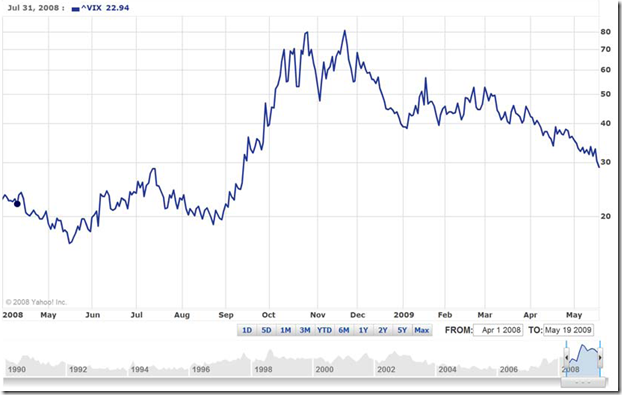
The financial crisis has morphed VIX into Wall Street's one-stop indicator that everyone references to see if investors are bullish or bearish toward stocks. When VIX rises, it's interpreted as a sign that investors are afraid to own stocks. When VIX declines, it means they're confident about stocks.

The VIX is the ticker symbol for the Chicago Board Options Volatility Index. It is an estimate of the  volatility in the S&P 500 index options and, accordingly, is sometimes called the fear index. The index is positively related to volatility under the assumption that it is more costly to insure against risk with options when the market is volatile. It is not correlated with the market, because a market can be highly volatile in both the upward and downward direction.

Data on the VIX and the chart below can be found at Yahoo Finance. As can be seen, there was a dramatic run up in the VIX at the end of last year. Since then it has been returning to previous levels. The VIX is calculated in real time, representing the expected volatility of puts and calls over the next 30 days. A value of 28 indicates that the expected annualized change in the S&P 500 over the next month is 28 percent. The one month movement of clip_image002[4]represents a change of one standard deviation over the next month. Consequently, given a VIX of 28  there is a 68 percent probability that movement in the S&P 500 will be within plus or minus 8.08 percent.

More information on the VIX is available at the CBOE
image

Thursday, May 7, 2009

Worst Decade for S&P

AllFinancialMatters.com has calculated the total return on the S&P for each decade since the 1930s. Given the current market the total return on the S&P for the decade following 2000 is –29.1%.

Thursday, December 4, 2008

The Graham Ratio Indicates the Market Does Not Suffer From Irrational Pessimism


Christopher D. Carroll in "Recent Stock Declines: Panic or the Purge of “Irrational Exuberance”? The Economists Voice, Vol. 5 (2008) presents new data on the Graham Ratio. As originally proposed by Benjamin Graham it is the ratio of stock prices to a 10-year average of lagged earnings. Carroll revises the ratio for a 12-year average of lagged earnings in order to more closely follow the political cycle. As indicated in the above diagram from the article, high values of the Graham ratio have signalled lower subsequent returns over the next 12 years. The current Graham ratio is about right in the center of the data plot indicating neither irrational exuberance or pessimism.

Sunday, November 30, 2008

Need to Learn About Securitization?

Even if you know how debt is securitized, this video by Paddy Hirsch at the Wallet is worth watching. He presents an entertaining and informative video on how credit card debt is turned into asset backed bonds.
marketplacevideos November 25, 2008